Astronomy news update from NASA :
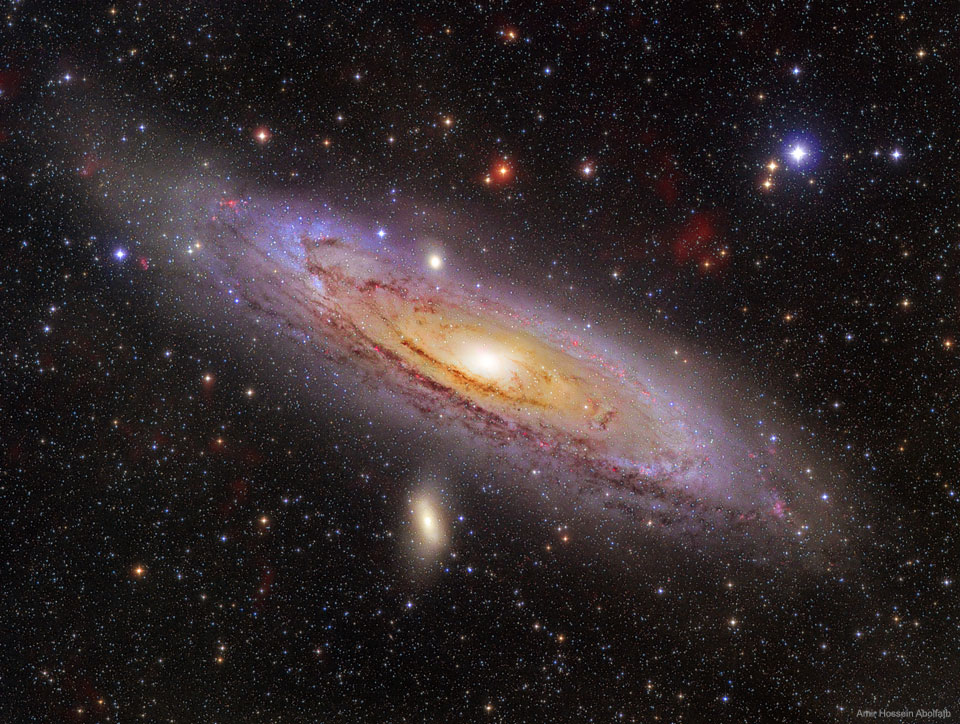
How far can you see? The most distant object easily visible to the unaided eye is M31, the great Andromeda Galaxy, over two million light-years away. Without a telescope, even this immense spiral galaxy appears as an unremarkable, faint, nebulous cloud in the constellation Andromeda. But a bright yellow nucleus, dark winding dust lanes, luminous blue spiral arms, and bright red emission nebulas are recorded in this stunning six-hour telescopic digital mosaic of our closest major galactic neighbor. While even casual skygazers are now inspired by the knowledge that there are many distant galaxies like M31, astronomers seriously debated this fundamental concept only 100 years ago. Were these "spiral nebulae" simply outlying gas clouds in our own Milky Way Galaxy or were they "island universes" -- distant galaxies of stars comparable to the Milky Way itself? This question was central to the famous Shapley-Curtis debate of 1920, which was later resolved by observations favoring Andromeda being just like our Milky Way Galaxy -- a conclusion making the rest of the universe much more vast than many had ever imagined.

from NASA https://ift.tt/2ZUfUyY
via IFTTT

By BY JACK NICAS, KAREN WEISE AND MIKE ISAAC from NYT Technology https://ift.tt/2ZRpJS8
via IFTTT

By BY STEVE LOHR from NYT Technology https://ift.tt/2ZXBPVY
via IFTTT
Astronomy news update from NASA :
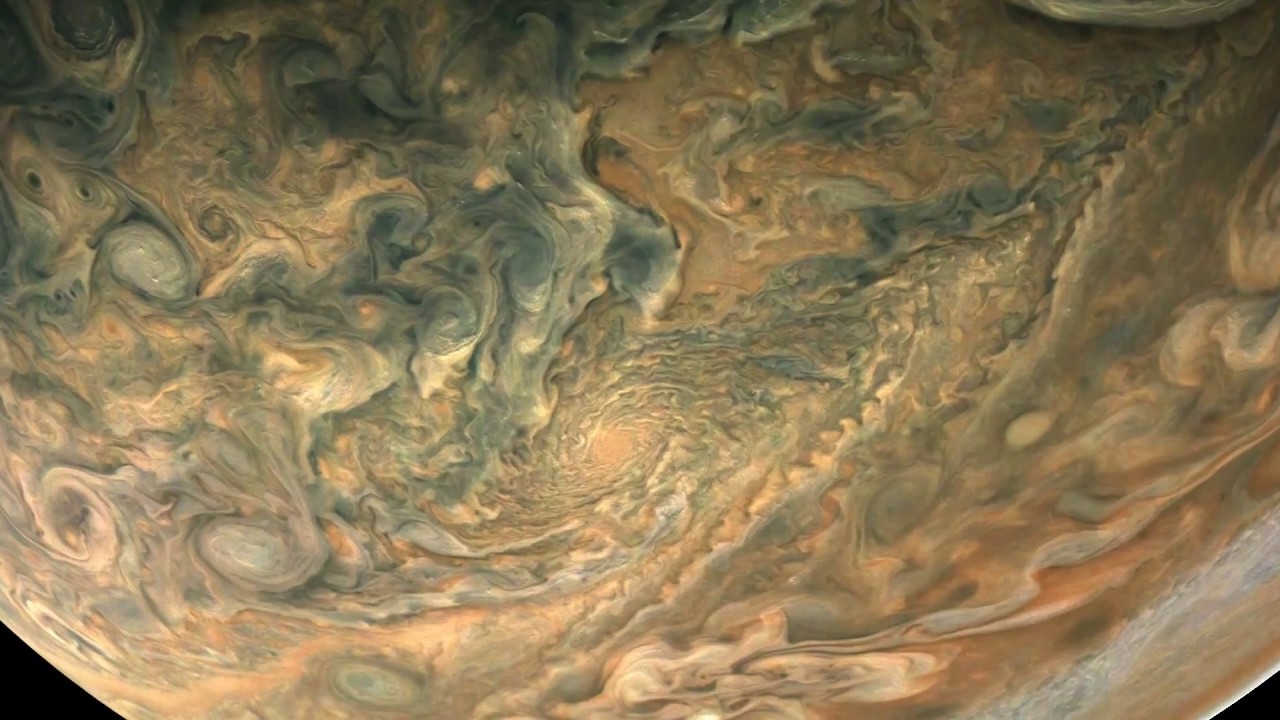
Here comes Jupiter! NASA's robotic spacecraft Juno is continuing on its 53-day, highly-elongated orbits around our Solar System's largest planet. The featured video is from perijove 11 in early 2018, the eleventh time Juno has passed near Jupiter since it arrived in mid-2016. This time-lapse, color-enhanced movie covers about four hours and morphs between 36 JunoCam images. The video begins with Jupiter rising as Juno approaches from the north. As Juno reaches its closest view -- from about 3,500 kilometers over Jupiter's cloud tops -- the spacecraft captures the great planet in tremendous detail. Juno passes light zones and dark belt of clouds that circle the planet, as well as numerous swirling circular storms, many of which are larger than hurricanes on Earth. After the perijove, Jupiter recedes into the distance, now displaying the unusual clouds that appear over Jupiter's south. To get desired science data, Juno swoops so close to Jupiter that its instruments are exposed to very high levels of radiation.

from NASA https://ift.tt/2I8jgZh
via IFTTT
Our new 'Word Of The Day' article update : bottle episode , n :
(originally US, television) An episode of a television series designed to be inexpensive and restricted in its use of sets, effects, cast members, etc. The first episode of the original Star Trek television series aired in the United States on this day in 1966. The term bottle episode is said to have originated from a nickname used by the cast and crew of the series for an episode set entirely on board the starship USS Enterprise.
Astronomy news update from NASA :
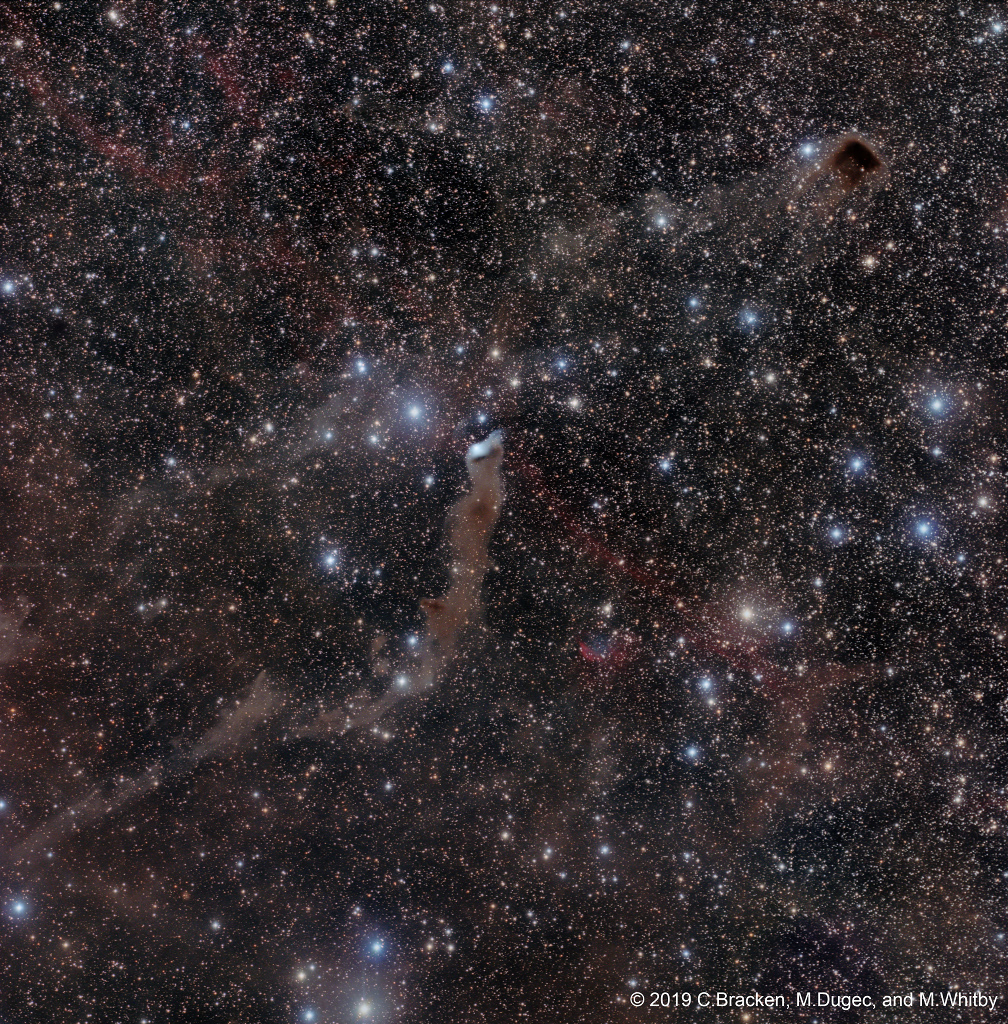
The mysterious blue reflection nebula found in catalogs as VdB 152 or Ced 201 really is very faint. It lies at the tip of the long dark nebula Barnard 175 in a dusty complex that has also been called Wolf's Cave. At the center of this deep and widefield telescopic view, the cosmic apparitions are nearly 1,400 light-years away along the northern Milky Way in the royal constellation Cepheus. Near the edge of a large molecular cloud, pockets of interstellar dust in the region block light from background stars or scatter light from the embedded bright star giving the the nebula its characteristic blue color. Ultraviolet light from the star is also thought to cause a dim reddish luminescence in the nebular dust. Though stars do form in molecular clouds, this star seems to have only accidentally wandered into the area, as its measured velocity through space is very different from the cloud's velocity. Another dense, obscuring dark nebula, LDN 1221, is easy to spot at the upper right in the frame, while the more colorful planetary nebula Dengel-Hartl 5 is just below center. Faint reddish emission from an ancient supernova remnant can also be traced (lower right to upper left) against the dust-rich complex in Cepheus.

from NASA https://ift.tt/313KwPR
via IFTTT
Our new 'Word Of The Day' article update : spit , n :
A thin metal or wooden rod on which meat is skewered for cooking, often over a fire. A generally low, narrow, pointed, usually sandy peninsula. […] (uncountable) Saliva, especially when expectorated. (countable) An instance of spitting; specifically, a light fall of rain or snow. […] The depth to which the blade of a spade goes into the soil when it is used for digging; a layer of soil of the depth of a spade's blade. The amount of soil that a spade holds; a spadeful.