Astronomy news update from NASA : 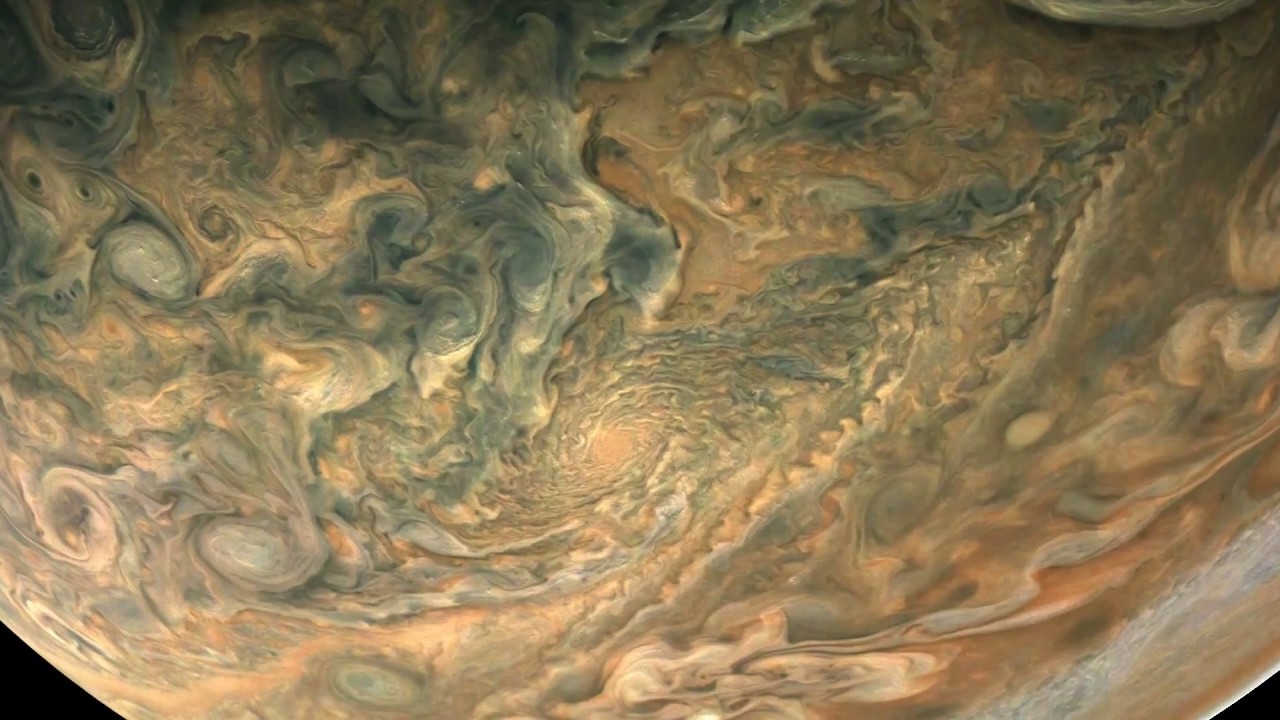
Here comes Jupiter! NASA's robotic spacecraft Juno is continuing on its 53-day, highly-elongated orbits around our Solar System's largest planet. The featured video is from perijove 11 in early 2018, the eleventh time Juno has passed near Jupiter since it arrived in mid-2016. This time-lapse, color-enhanced movie covers about four hours and morphs between 36 JunoCam images. The video begins with Jupiter rising as Juno approaches from the north. As Juno reaches its closest view -- from about 3,500 kilometers over Jupiter's cloud tops -- the spacecraft captures the great planet in tremendous detail. Juno passes light zones and dark belt of clouds that circle the planet, as well as numerous swirling circular storms, many of which are larger than hurricanes on Earth. After the perijove, Jupiter recedes into the distance, now displaying the unusual clouds that appear over Jupiter's south. To get desired science data, Juno swoops so close to Jupiter that its instruments are exposed to very high levels of radiation.
from NASA https://ift.tt/2I8jgZh
via IFTTT
Here comes Jupiter! NASA's robotic spacecraft Juno is continuing on its 53-day, highly-elongated orbits around our Solar System's largest planet. The featured video is from perijove 11 in early 2018, the eleventh time Juno has passed near Jupiter since it arrived in mid-2016. This time-lapse, color-enhanced movie covers about four hours and morphs between 36 JunoCam images. The video begins with Jupiter rising as Juno approaches from the north. As Juno reaches its closest view -- from about 3,500 kilometers over Jupiter's cloud tops -- the spacecraft captures the great planet in tremendous detail. Juno passes light zones and dark belt of clouds that circle the planet, as well as numerous swirling circular storms, many of which are larger than hurricanes on Earth. After the perijove, Jupiter recedes into the distance, now displaying the unusual clouds that appear over Jupiter's south. To get desired science data, Juno swoops so close to Jupiter that its instruments are exposed to very high levels of radiation.
from NASA https://ift.tt/2I8jgZh
via IFTTT