

Hello guys, We're here with some new information from NASA : 
Spitzer Space Telescope into orbit around the Sun on Aug. 25, 2003. Since then, the observatory has been lifting the veil on the wonders of the cosmos, from our own solar system to faraway galaxies, using infrared light.
from NASA https://ift.tt/2NF8CMW
via IFTTT
Spitzer Space Telescope into orbit around the Sun on Aug. 25, 2003. Since then, the observatory has been lifting the veil on the wonders of the cosmos, from our own solar system to faraway galaxies, using infrared light.
from NASA https://ift.tt/2NF8CMW
via IFTTT
Astronomy news update from NASA : 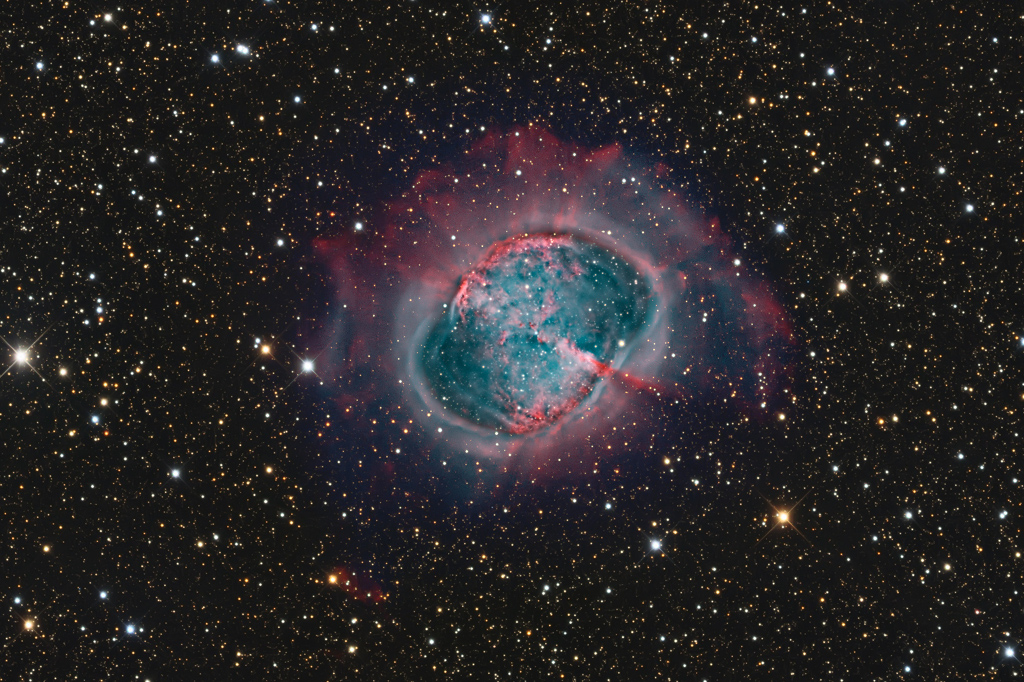
While hunting for comets in the skies above 18th century France, astronomer Charles Messier diligently kept a list of the things he encountered that were definitely not comets. This is number 27 on his now famous not-a-comet list. In fact, 21st century astronomers would identify it as a planetary nebula, but it's not a planet either, even though it may appear round and planet-like in a small telescope. Messier 27 (M27) is an excellent example of a gaseous emission nebula created as a sun-like star runs out of nuclear fuel in its core. The nebula forms as the star's outer layers are expelled into space, with a visible glow generated by atoms excited by the dying star's intense but invisible ultraviolet light. Known by the popular name of the Dumbbell Nebula, the beautifully symmetric interstellar gas cloud is over 2.5 light-years across and about 1,200 light-years away in the constellation Vulpecula. This impressive color composite highlights details within the well-studied central region and fainter, seldom imaged features in the nebula's outer halo. It incorporates broad and narrowband images recorded using filters sensitive to emission from hydrogen and oxygen atoms.
from NASA https://ift.tt/2ZyLJNA
via IFTTT
While hunting for comets in the skies above 18th century France, astronomer Charles Messier diligently kept a list of the things he encountered that were definitely not comets. This is number 27 on his now famous not-a-comet list. In fact, 21st century astronomers would identify it as a planetary nebula, but it's not a planet either, even though it may appear round and planet-like in a small telescope. Messier 27 (M27) is an excellent example of a gaseous emission nebula created as a sun-like star runs out of nuclear fuel in its core. The nebula forms as the star's outer layers are expelled into space, with a visible glow generated by atoms excited by the dying star's intense but invisible ultraviolet light. Known by the popular name of the Dumbbell Nebula, the beautifully symmetric interstellar gas cloud is over 2.5 light-years across and about 1,200 light-years away in the constellation Vulpecula. This impressive color composite highlights details within the well-studied central region and fainter, seldom imaged features in the nebula's outer halo. It incorporates broad and narrowband images recorded using filters sensitive to emission from hydrogen and oxygen atoms.
from NASA https://ift.tt/2ZyLJNA
via IFTTT
Our new 'Word Of The Day' article update : ex contractu , adj :
(law, postpositive) Of a legal obligation: arising from a contractual relationship.
(law, postpositive) Of a legal obligation: arising from a contractual relationship.

More UFOs Than Ever Before via Digg https://ift.tt/34654Jy
Hello, Information from NASA NASA has awarded the Flight Dynamics Support Services (FDSS) III contract, a small business set-aside, to OPR, LLC of Beltsville, Maryland, to provide flight dynamics support services to, and related service support for, the Engineering and Technology Directorate’s Mission and Systems Analysis Division at NASA’s Goddard Space Flight Center in Green
August 28, 2019
from NASA https://ift.tt/2ZxguGx
August 28, 2019
from NASA https://ift.tt/2ZxguGx


