Astronomy news update from NASA :
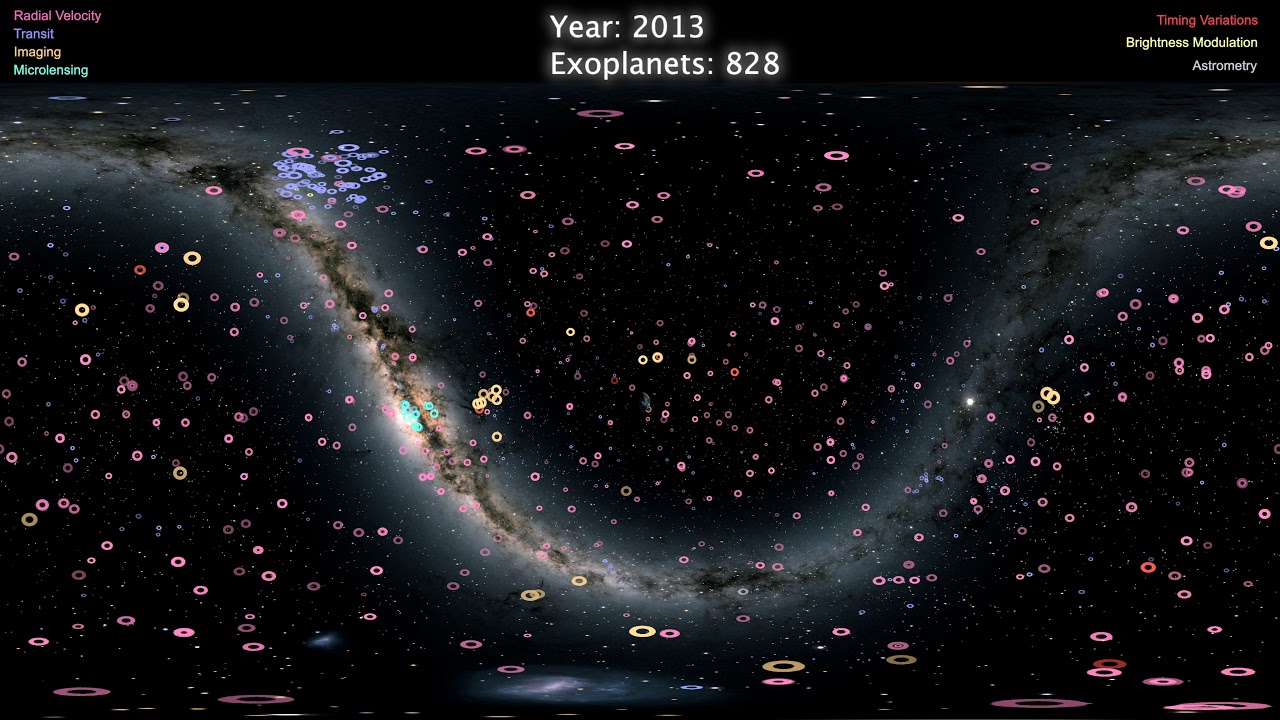
Over 4000 planets are now known to exist outside our Solar System. Known as
exoplanets, this milestone was passed last month, as recorded by
NASA's Exoplanet Archive. The
featured video highlights these exoplanets in sound and light, starting chronologically from the first confirmed detection in 1992. The entire night sky is first
shown compressed with the
central band of our
Milky Way Galaxy making a giant U.
Exoplanets detected by slight jiggles in their parents-star's colors (
radial velocity) appear in pink, while those detected by slight dips in their parent star's brightness (
transit) are shown in purple. Further, those exoplanets
imaged directly appear in orange, while those detected by
gravitationally magnifying the light of a background star (
microlensing) are shown in green. The faster a planet orbits its parent star, the higher the accompanying
tone played. The
retired Kepler satellite has discovered
about half of these first 4000 exoplanets in just one region of the sky, while the new
TESS mission is on track to find even more, all over the sky, orbiting the
brightest nearby stars. Finding
exoplanets not only helps humanity to better understand the potential
prevalence of life elsewhere in the universe, but also how our
Earth and
Solar System were formed.
from NASA https://ift.tt/2YSAiRv
via
IFTTT


