
Our new 'Word Of The Day' article update : gastrodiplomacy , n :
A type of cultural diplomacy where relations between representatives of different cultures are improved by the means of gastronomy and the promotion of national cuisines. Today is the eve of Sustainable Gastronomy Day, which is designated by the United Nations to highlight the role that gastronomy can play in promoting sustainable development.
A type of cultural diplomacy where relations between representatives of different cultures are improved by the means of gastronomy and the promotion of national cuisines. Today is the eve of Sustainable Gastronomy Day, which is designated by the United Nations to highlight the role that gastronomy can play in promoting sustainable development.
Astronomy news update from NASA : 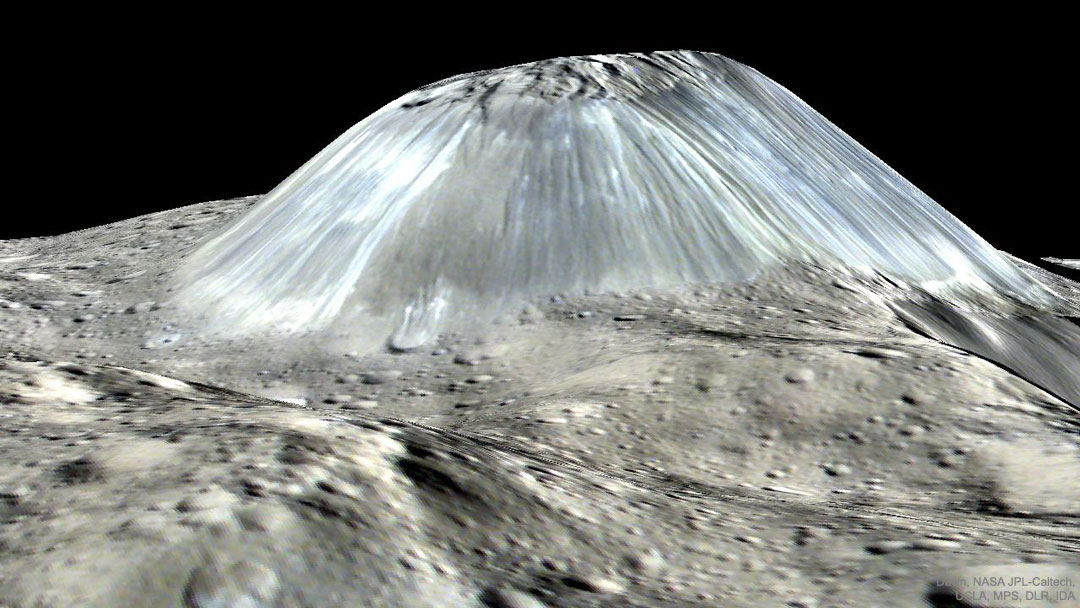
What created this unusual mountain? There is a new theory. Ahuna Mons is the largest mountain on the largest known asteroid in our Solar System, Ceres, which orbits our Sun in the main asteroid belt between Mars and Jupiter. Ahuna Mons, though, is like nothing that humanity has ever seen before. For one thing, its slopes are garnished not with old craters but young vertical streaks. The new hypothesis, based on numerous gravity measurements, holds that a bubble of mud rose from deep within the dwarf planet and pushed through the icy surface at a weak point rich in reflective salt -- and then froze. The bright streaks are thought to be similar to other recently surfaced material such as visible in Ceres' famous bright spots. The featured double-height digital image was constructed from surface maps taken of Ceres in 2016 by the robotic Dawn mission. Successfully completing its mission in 2018, Dawn continues to orbit Ceres even though it has exhausted the fuel needed to keep its antennas pointed toward Earth.
from NASA https://go.nasa.gov/2ZqRu06
via IFTTT
What created this unusual mountain? There is a new theory. Ahuna Mons is the largest mountain on the largest known asteroid in our Solar System, Ceres, which orbits our Sun in the main asteroid belt between Mars and Jupiter. Ahuna Mons, though, is like nothing that humanity has ever seen before. For one thing, its slopes are garnished not with old craters but young vertical streaks. The new hypothesis, based on numerous gravity measurements, holds that a bubble of mud rose from deep within the dwarf planet and pushed through the icy surface at a weak point rich in reflective salt -- and then froze. The bright streaks are thought to be similar to other recently surfaced material such as visible in Ceres' famous bright spots. The featured double-height digital image was constructed from surface maps taken of Ceres in 2016 by the robotic Dawn mission. Successfully completing its mission in 2018, Dawn continues to orbit Ceres even though it has exhausted the fuel needed to keep its antennas pointed toward Earth.
from NASA https://go.nasa.gov/2ZqRu06
via IFTTT

Greenland Lost 2 Billion Tons Of Ice Yesterday, Which Is Very Unusual via Digg https://cnn.it/2XjrZQQ
Our new 'Word Of The Day' article update : nuke , v :
(transitive, chiefly US, colloquial) To use a nuclear weapon on a target. (transitive, chiefly US, colloquial, figuratively) To destroy or erase completely. (transitive, Internet slang, by extension) To carry out a denial-of-service attack against (an IRC user). (transitive, chiefly US, colloquial) To expose to some form of radiation. (transitive, chiefly US, colloquial) To cook in a microwave oven.
(transitive, chiefly US, colloquial) To use a nuclear weapon on a target. (transitive, chiefly US, colloquial, figuratively) To destroy or erase completely. (transitive, Internet slang, by extension) To carry out a denial-of-service attack against (an IRC user). (transitive, chiefly US, colloquial) To expose to some form of radiation. (transitive, chiefly US, colloquial) To cook in a microwave oven.

Raptors Send Toronto Into Raptures As They Beat Warriors To Take First NBA Title via Digg http://bit.ly/2Ifn9ff


