'It Was Like A Zoo:' Death On An Unruly, Overcrowded Everest via Digg https://nyti.ms/2M9XcSl
Astronomy news update from NASA : 
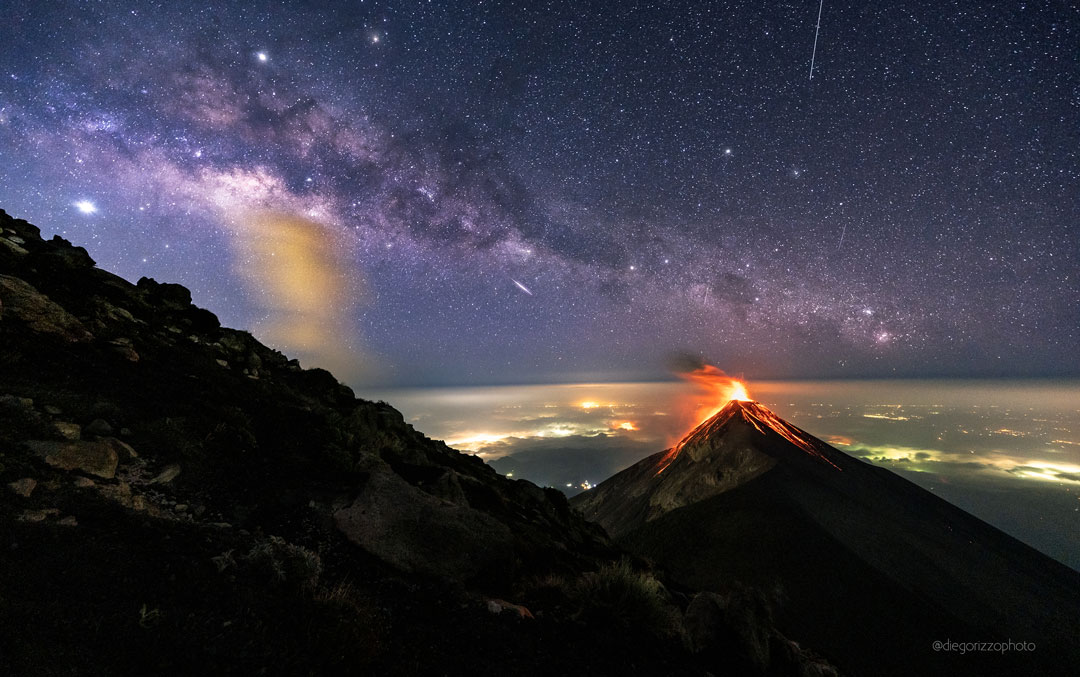
Sometimes it's hard to decide which is more impressive -- the land or the sky. On the land of the featured image, for example, the Volcano of Fire (Volcán de Fuego) is seen erupting topped by red-hot, wind-blown ash and with streams of glowing lava running down its side. Lights from neighboring towns are seen through a thin haze below. In the sky, though, the central plane of our Milky Way Galaxy runs diagonally from the upper left, with a fleeting meteor just below, and the trail of a satellite to the upper right. The planet Jupiter also appears toward the upper left, with the bright star Antares just to its right. Much of the land and the sky were captured together in a single, well-timed, 25-second exposure taken in mid-April from the side of Fuego's sister volcano Acatenango in Guatemala. The image of the meteor, though, was captured in a similar frame taken about 30 minutes earlier -- when the volanic eruption was not as photogenic -- and added later digitally.
from NASA https://go.nasa.gov/2X8erVd
via IFTTT

Sometimes it's hard to decide which is more impressive -- the land or the sky. On the land of the featured image, for example, the Volcano of Fire (Volcán de Fuego) is seen erupting topped by red-hot, wind-blown ash and with streams of glowing lava running down its side. Lights from neighboring towns are seen through a thin haze below. In the sky, though, the central plane of our Milky Way Galaxy runs diagonally from the upper left, with a fleeting meteor just below, and the trail of a satellite to the upper right. The planet Jupiter also appears toward the upper left, with the bright star Antares just to its right. Much of the land and the sky were captured together in a single, well-timed, 25-second exposure taken in mid-April from the side of Fuego's sister volcano Acatenango in Guatemala. The image of the meteor, though, was captured in a similar frame taken about 30 minutes earlier -- when the volanic eruption was not as photogenic -- and added later digitally.
from NASA https://go.nasa.gov/2X8erVd
via IFTTT
Our new 'Word Of The Day' article update : gouge , v :
(transitive) To make a groove, hole, or mark in by scooping with or as if with a gouge. (transitive) To cheat or impose upon; in particular, to charge an unfairly or unreasonably high price. (transitive, intransitive) To dig or scoop (something) out with or as if with a gouge; in particular, to use a thumb to push or try to push the eye (of a person) out of its socket. (intransitive) To use a gouge.
Astronomy news update from NASA : 
One of the most spectacular solar sights is an erupting prominence. In 2011, NASA's Sun-orbiting Solar Dynamic Observatory spacecraft imaged an impressively large prominence erupting from the surface. The dramatic explosion was captured in ultraviolet light in the featured time lapse video covering 90 minutes, where a new frame was taken every 24 seconds. The scale of the prominence is huge -- the entire Earth would easily fit under the flowing curtain of hot gas. A solar prominence is channeled and sometimes held above the Sun's surface by the Sun's magnetic field. A quiescent prominence typically lasts about a month, and may erupt in a Coronal Mass Ejection (CME) expelling hot gas into the Solar System. The energy mechanism that creates a solar prominence is still a topic of research. After our Sun passes the current Solar Minimum, solar activity like eruptive prominences are expected to become more common over the next few years.
from NASA https://go.nasa.gov/2VT3XY5
via IFTTT

One of the most spectacular solar sights is an erupting prominence. In 2011, NASA's Sun-orbiting Solar Dynamic Observatory spacecraft imaged an impressively large prominence erupting from the surface. The dramatic explosion was captured in ultraviolet light in the featured time lapse video covering 90 minutes, where a new frame was taken every 24 seconds. The scale of the prominence is huge -- the entire Earth would easily fit under the flowing curtain of hot gas. A solar prominence is channeled and sometimes held above the Sun's surface by the Sun's magnetic field. A quiescent prominence typically lasts about a month, and may erupt in a Coronal Mass Ejection (CME) expelling hot gas into the Solar System. The energy mechanism that creates a solar prominence is still a topic of research. After our Sun passes the current Solar Minimum, solar activity like eruptive prominences are expected to become more common over the next few years.
from NASA https://go.nasa.gov/2VT3XY5
via IFTTT
Our new 'Word Of The Day' article update : facticity , n :
(uncountable) The quality or state of being a fact. (uncountable, specifically, philosophy) In existentialism, the state of being in the world without any knowable reason for such existence, or of being in a particular state of affairs which one has no control over. (countable) A fact that is not changeable or that is assumed to be true without further evaluation.