

Hello guys, We're here with some new information from NASA : 
NGC 2903 is located about 30 million light-years away in the constellation of Leo (the Lion), and was studied as part of a Hubble survey of the central regions of roughly 145 nearby disk galaxies.
from NASA https://go.nasa.gov/2DJrswQ
via IFTTT
NGC 2903 is located about 30 million light-years away in the constellation of Leo (the Lion), and was studied as part of a Hubble survey of the central regions of roughly 145 nearby disk galaxies.
from NASA https://go.nasa.gov/2DJrswQ
via IFTTT

Astronomy news update from NASA : 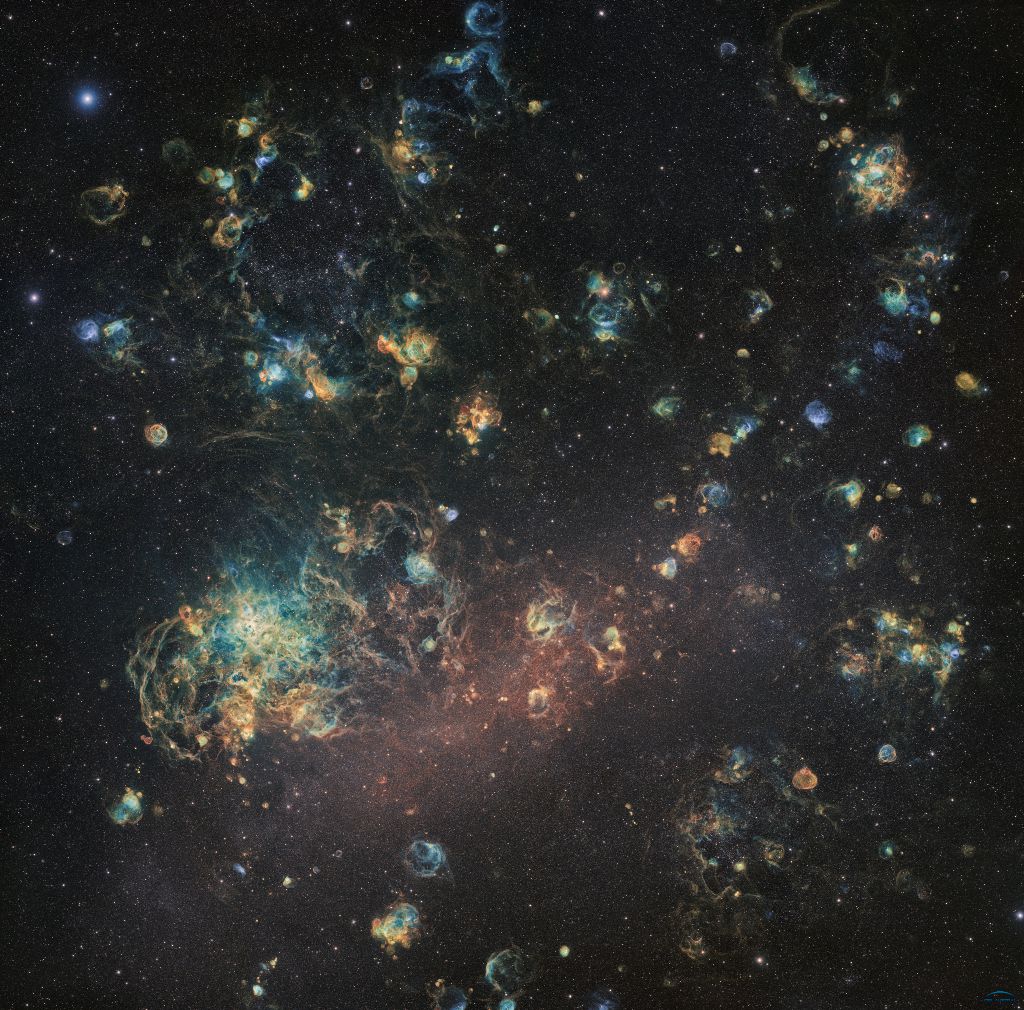
The Large Magellanic Cloud (LMC) is an alluring sight in southern skies. But this deep and detailed telescopic view, over 10 months in the making, goes beyond what is visible to most circumnavigators of planet Earth. Spanning over 5 degrees or 10 full moons, the 4x4 panel mosaic was constructed from 3900 frames with a total of 1,060 hours of exposure time in both broadband and narrowband filters. The narrowband filters are designed to transmit only light emitted by sulfur, hydrogen, and oxygen atoms. Ionized by energetic starlight, the atoms emit their characteristic light as electrons are recaptured and the atoms transition to a lower energy state. As a result, in this image the LMC seems covered with its own clouds of ionized gas surrounding its massive, young stars. Sculpted by the strong stellar winds and ultraviolet radiation, the glowing clouds, dominated by emission from hydrogen, are known as H II (ionized hydrogen) regions. Itself composed of many overlapping H II regions, the Tarantula Nebula is the large star forming region at the left. The largest satellite of our Milky Way Galaxy, the LMC is about 15,000 light-years across and lies a mere 160,000 light-years away toward the constellation Dorado.
from NASA https://go.nasa.gov/2VhJHUY
via IFTTT
The Large Magellanic Cloud (LMC) is an alluring sight in southern skies. But this deep and detailed telescopic view, over 10 months in the making, goes beyond what is visible to most circumnavigators of planet Earth. Spanning over 5 degrees or 10 full moons, the 4x4 panel mosaic was constructed from 3900 frames with a total of 1,060 hours of exposure time in both broadband and narrowband filters. The narrowband filters are designed to transmit only light emitted by sulfur, hydrogen, and oxygen atoms. Ionized by energetic starlight, the atoms emit their characteristic light as electrons are recaptured and the atoms transition to a lower energy state. As a result, in this image the LMC seems covered with its own clouds of ionized gas surrounding its massive, young stars. Sculpted by the strong stellar winds and ultraviolet radiation, the glowing clouds, dominated by emission from hydrogen, are known as H II (ionized hydrogen) regions. Itself composed of many overlapping H II regions, the Tarantula Nebula is the large star forming region at the left. The largest satellite of our Milky Way Galaxy, the LMC is about 15,000 light-years across and lies a mere 160,000 light-years away toward the constellation Dorado.
from NASA https://go.nasa.gov/2VhJHUY
via IFTTT
Our new 'Word Of The Day' article update : Betteridge's law , proper n :
(journalism) An adage stating that any headline ending in a question mark can be correctly answered by the word "no". Today is World Press Freedom Day, which is recognized by the United Nations to raise awareness of the importance of freedom of the press and remind governments of their duty to respect and uphold the right to freedom of expression.
(journalism) An adage stating that any headline ending in a question mark can be correctly answered by the word "no". Today is World Press Freedom Day, which is recognized by the United Nations to raise awareness of the importance of freedom of the press and remind governments of their duty to respect and uphold the right to freedom of expression.

The Many Human Errors That Brought Down The Boeing 737 Max via Digg http://bit.ly/2GPi4IG


