
Hello guys, We're here with some new information from NASA : 
The International Space Station crew snapped this image of the Hudson Bay's frozen southern tip.
from NASA https://go.nasa.gov/2UI1WNP
via IFTTT
The International Space Station crew snapped this image of the Hudson Bay's frozen southern tip.
from NASA https://go.nasa.gov/2UI1WNP
via IFTTT
Hello, Information from NASA Media are invited to hear experts from around the world discuss the latest research on near-Earth objects (NEOs) at the International Academy of Astronautics’ 2019 Planetary Defense Conference Monday, April 29 through Friday, May 3 at The Hotel at the University of Maryland.
April 25, 2019
from NASA https://go.nasa.gov/2L60Goj
April 25, 2019
from NASA https://go.nasa.gov/2L60Goj

Astronomy news update from NASA : 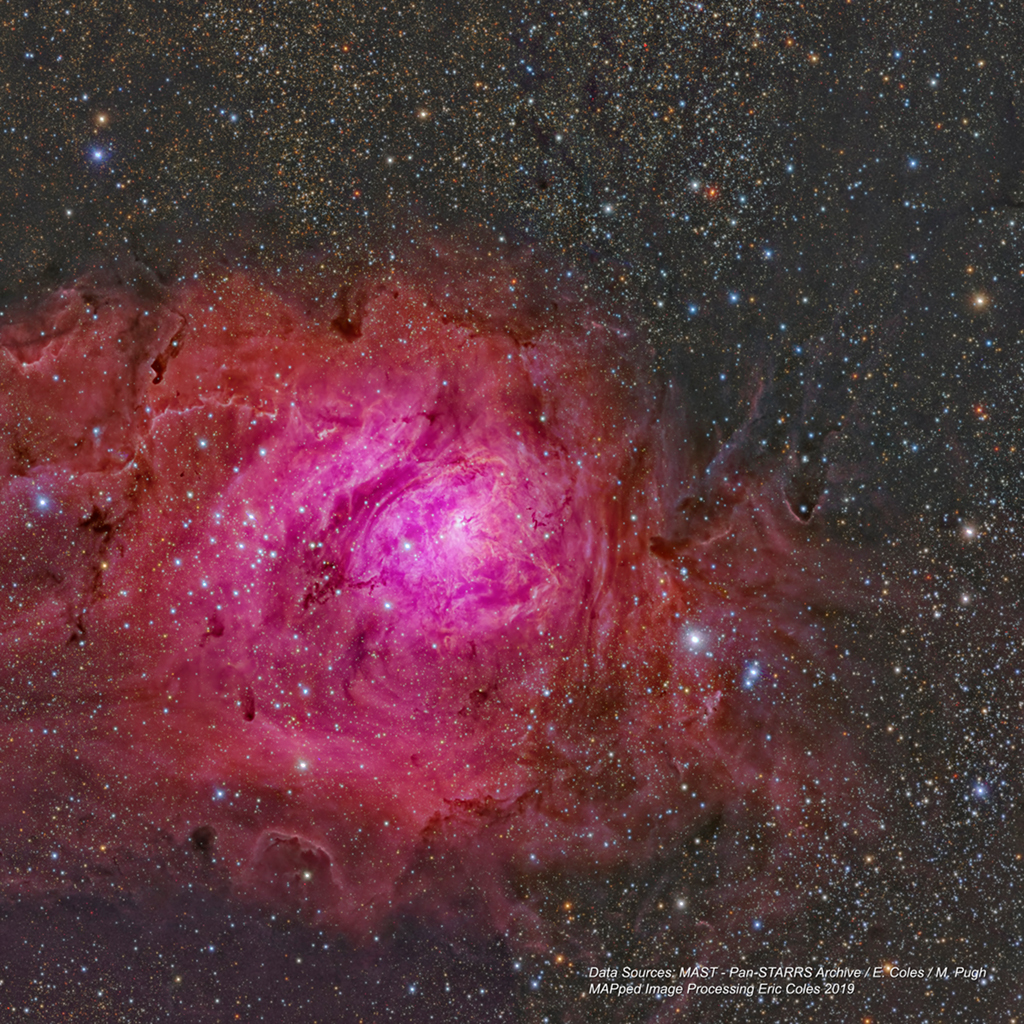
Ridges of glowing interstellar gas and dark dust clouds inhabit the turbulent, cosmic depths of the Lagoon Nebula. Also known as M8, the bright star forming region is about 5,000 light-years distant. But it still makes for a popular stop on telescopic tours of the constellation Sagittarius, toward the center of our Milky Way Galaxy. Dominated by the telltale red emission of ionized hydrogen atoms recombining with stripped electrons, this stunning view of the Lagoon is over 100 light-years across. At its center, the bright, compact, hourglass shape is gas ionized and sculpted by energetic radiation and extreme stellar winds from a massive young star. In fact, the many bright stars of open cluster NGC 6530 drift within the nebula, just formed in the Lagoon several million years ago. Broadband image data from Pan-STARRS (Panoramic Survey Telescope & Rapid Response System) was combined with narrowband data from amateur telescopes to create this wide and deep portrait of the Lagoon Nebula.
from NASA https://go.nasa.gov/2IEdX5t
via IFTTT
Ridges of glowing interstellar gas and dark dust clouds inhabit the turbulent, cosmic depths of the Lagoon Nebula. Also known as M8, the bright star forming region is about 5,000 light-years distant. But it still makes for a popular stop on telescopic tours of the constellation Sagittarius, toward the center of our Milky Way Galaxy. Dominated by the telltale red emission of ionized hydrogen atoms recombining with stripped electrons, this stunning view of the Lagoon is over 100 light-years across. At its center, the bright, compact, hourglass shape is gas ionized and sculpted by energetic radiation and extreme stellar winds from a massive young star. In fact, the many bright stars of open cluster NGC 6530 drift within the nebula, just formed in the Lagoon several million years ago. Broadband image data from Pan-STARRS (Panoramic Survey Telescope & Rapid Response System) was combined with narrowband data from amateur telescopes to create this wide and deep portrait of the Lagoon Nebula.
from NASA https://go.nasa.gov/2IEdX5t
via IFTTT
Our new 'Word Of The Day' article update : chur , interj :
(New Zealand, informal) A strong voicing of agreement, approval, or thanks: awesome!, cheers!, ta!, thanks!. (New Zealand, informal) A parting salutation: bye, see you later. Today is ANZAC Day in Australia and New Zealand, which commemorates the contributions and sacrifices of those who have served in wars, conflicts and peacekeeping operations.
(New Zealand, informal) A strong voicing of agreement, approval, or thanks: awesome!, cheers!, ta!, thanks!. (New Zealand, informal) A parting salutation: bye, see you later. Today is ANZAC Day in Australia and New Zealand, which commemorates the contributions and sacrifices of those who have served in wars, conflicts and peacekeeping operations.


