
Astronomy news update from NASA : 
Sit back and watch two black holes merge. Inspired by the first direct detection of gravitational waves in 2015, this simulation video plays in slow motion but would take about one third of a second if run in real time. Set on a cosmic stage the black holes are posed in front of stars, gas, and dust. Their extreme gravity lenses the light from behind them into Einstein rings as they spiral closer and finally merge into one. The otherwise invisible gravitational waves generated as the massive objects rapidly coalesce cause the visible image to ripple and slosh both inside and outside the Einstein rings even after the black holes have merged. Dubbed GW150914, the gravitational waves detected by LIGO are consistent with the merger of 36 and 31 solar mass black holes at a distance of 1.3 billion light-years. The final, single black hole has 63 times the mass of the Sun, with the remaining 3 solar masses converted into energy in gravitational waves. Since then the LIGO and VIRGO gravitational wave observatories have reported several more detections of merging massive systems, while last week the Event Horizon Telescope reported the first horizon-scale image of a black hole.
from NASA https://go.nasa.gov/2ZcnBkH
via IFTTT
Sit back and watch two black holes merge. Inspired by the first direct detection of gravitational waves in 2015, this simulation video plays in slow motion but would take about one third of a second if run in real time. Set on a cosmic stage the black holes are posed in front of stars, gas, and dust. Their extreme gravity lenses the light from behind them into Einstein rings as they spiral closer and finally merge into one. The otherwise invisible gravitational waves generated as the massive objects rapidly coalesce cause the visible image to ripple and slosh both inside and outside the Einstein rings even after the black holes have merged. Dubbed GW150914, the gravitational waves detected by LIGO are consistent with the merger of 36 and 31 solar mass black holes at a distance of 1.3 billion light-years. The final, single black hole has 63 times the mass of the Sun, with the remaining 3 solar masses converted into energy in gravitational waves. Since then the LIGO and VIRGO gravitational wave observatories have reported several more detections of merging massive systems, while last week the Event Horizon Telescope reported the first horizon-scale image of a black hole.
from NASA https://go.nasa.gov/2ZcnBkH
via IFTTT
Our new 'Word Of The Day' article update : pang , v :
(transitive) To cause to have great pain or suffering; to torment, to torture.
(transitive) To cause to have great pain or suffering; to torment, to torture.

Stephen Curry Has A Popcorn Problem via Digg https://nyti.ms/2DeuxVd


Astronomy news update from NASA : 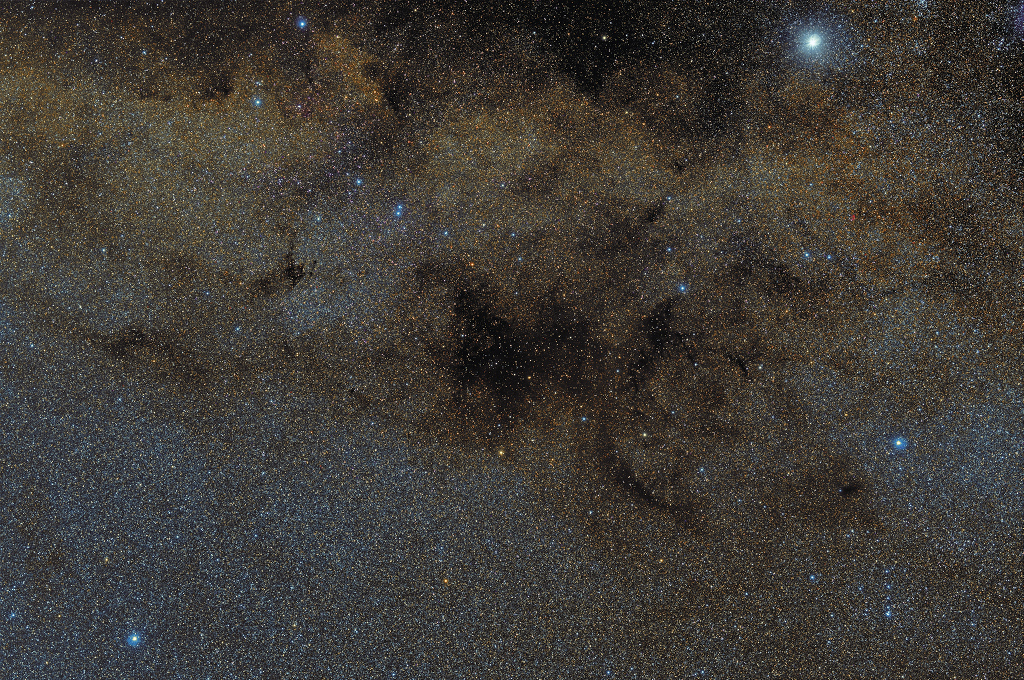
Rigil Kentaurus is the bright star near the top of this broad southern skyscape. Of course it's probably better known as Alpha Centauri, nearest star system to the Sun. Below it sprawls a dark nebula complex. The obscuring interstellar dust clouds include Sandqvist catalog clouds 169 and 172 in silhouette against the rich starfields along the southern Milky Way. Rigil Kent is a mere 4.37 light-years away, but the dusty dark nebulae lie at the edge of the starforming Circinus-West molecular cloud about 2,500 light-years distant. The wide-field of view spans over 12 degrees (24 full moons) across southern skies.
from NASA https://go.nasa.gov/2DcAcei
via IFTTT
Rigil Kentaurus is the bright star near the top of this broad southern skyscape. Of course it's probably better known as Alpha Centauri, nearest star system to the Sun. Below it sprawls a dark nebula complex. The obscuring interstellar dust clouds include Sandqvist catalog clouds 169 and 172 in silhouette against the rich starfields along the southern Milky Way. Rigil Kent is a mere 4.37 light-years away, but the dusty dark nebulae lie at the edge of the starforming Circinus-West molecular cloud about 2,500 light-years distant. The wide-field of view spans over 12 degrees (24 full moons) across southern skies.
from NASA https://go.nasa.gov/2DcAcei
via IFTTT


