Astronomy news update from NASA : 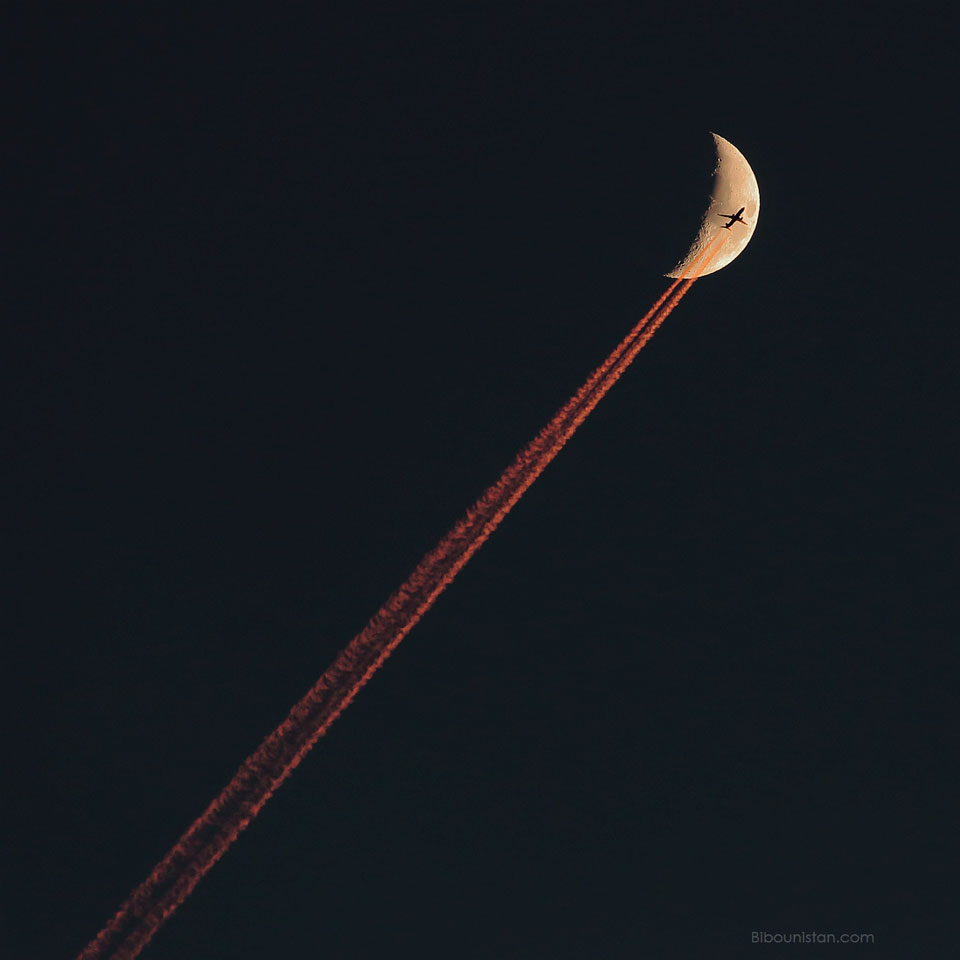
No, this is not a good way to get to the Moon. What is pictured is a chance superposition of an airplane and the Moon. The contrail would normally appear white, but the large volume of air toward the setting Sun preferentially knocks away blue light, giving the reflected trail a bright red hue. Far in the distance, well behind the plane, is a crescent Moon, also slightly reddened. Captured a month ago above Valais, Switzerland, the featured image was taken so soon after sunset that planes in the sky were still in sunlight, as were their contrails. Within minutes, unfortunately, the impromptu sky show ended. The plane crossed the Moon and moved out of sight. The Moon set. The contrail became unilluminated and then dispersed.
from NASA https://go.nasa.gov/2tqTvM1
via IFTTT
No, this is not a good way to get to the Moon. What is pictured is a chance superposition of an airplane and the Moon. The contrail would normally appear white, but the large volume of air toward the setting Sun preferentially knocks away blue light, giving the reflected trail a bright red hue. Far in the distance, well behind the plane, is a crescent Moon, also slightly reddened. Captured a month ago above Valais, Switzerland, the featured image was taken so soon after sunset that planes in the sky were still in sunlight, as were their contrails. Within minutes, unfortunately, the impromptu sky show ended. The plane crossed the Moon and moved out of sight. The Moon set. The contrail became unilluminated and then dispersed.
from NASA https://go.nasa.gov/2tqTvM1
via IFTTT

Have We Gotten Animal Cognition Totally Wrong? via Digg http://bit.ly/2E3Rdbz
Our new 'Word Of The Day' article update : living fossil , n :
Any species discovered first as a fossil and believed extinct, but which is later found living; an organism that has remained unchanged over geological periods. Any living species which very closely resembles fossil relatives in most anatomical details. English biologist, geologist, and naturalist Charles Darwin, who coined the term and who is best known for his contributions towards the science of evolution, was born on this day 210 years ago in 1809.
Any species discovered first as a fossil and believed extinct, but which is later found living; an organism that has remained unchanged over geological periods. Any living species which very closely resembles fossil relatives in most anatomical details. English biologist, geologist, and naturalist Charles Darwin, who coined the term and who is best known for his contributions towards the science of evolution, was born on this day 210 years ago in 1809.
Hello guys, We're here with some new information from NASA : 
Erosion of the surface reveals several shades of light toned layers, likely sedimentary deposits, as shown in this image taken by the HiRISE camera on the Mars Reconnaissance Orbiter.
from NASA https://go.nasa.gov/2GmCw5U
via IFTTT
Erosion of the surface reveals several shades of light toned layers, likely sedimentary deposits, as shown in this image taken by the HiRISE camera on the Mars Reconnaissance Orbiter.
from NASA https://go.nasa.gov/2GmCw5U
via IFTTT
Astronomy news update from NASA : 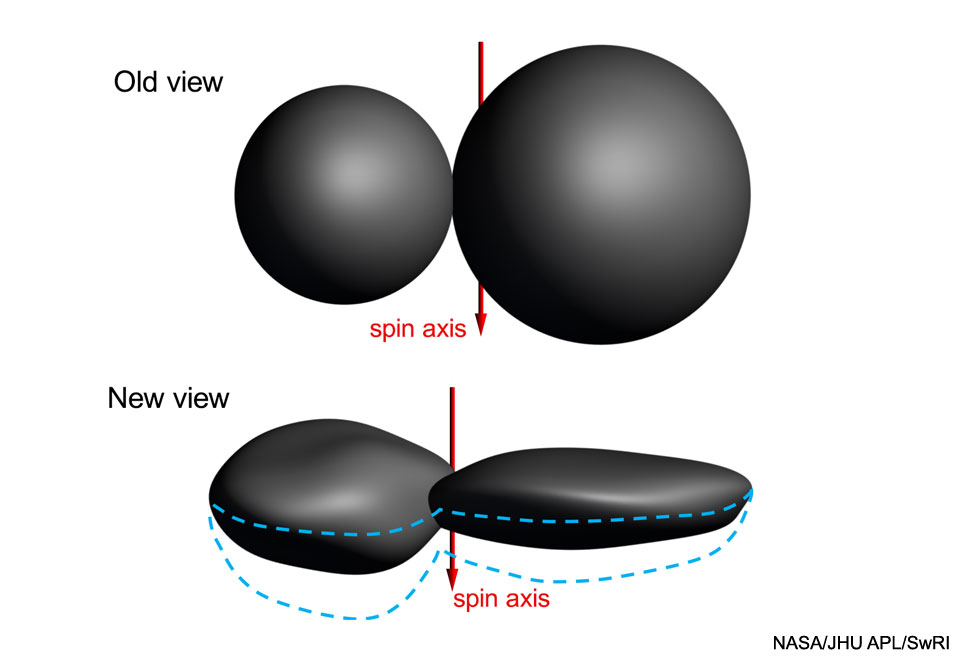
Ultima Thule is not the object humanity thought that it was last month. When the robotic New Horizons spacecraft zoomed past the distant asteroid Ultima Thule (officially 2014 MU69) in early January, early images showed two circular lobes that when most simply extrapolated to 3D were thought to be, roughly, spheres. However, analyses of newly beamed-back images -- including many taken soon after closest approach -- shows eclipsed stars re-appearing sooner than expected. The only explanation possible is that this 30-km long Kuiper belt object has a different 3D shape than believed only a few weeks ago. Specifically, as shown in the featured illustration, it now appears that the larger lobe -- Ultima -- is more similar to a fluffy pancake than a sphere, while the smaller lobe -- Thule -- resembles a dented walnut. The remaining uncertainty in the outlines are shown by the dashed blue lines. The new shape information indicates that gravity -- which contracts more massive bodies into spheres -- played perhaps less of a role in contouring the lobes of Ultima Thule than previously thought. The New Horizons spacecraft continued on to Ultima Thule after passing Pluto in mid-2015. New data and images are still being received.
from NASA https://go.nasa.gov/2THETDp
via IFTTT
Ultima Thule is not the object humanity thought that it was last month. When the robotic New Horizons spacecraft zoomed past the distant asteroid Ultima Thule (officially 2014 MU69) in early January, early images showed two circular lobes that when most simply extrapolated to 3D were thought to be, roughly, spheres. However, analyses of newly beamed-back images -- including many taken soon after closest approach -- shows eclipsed stars re-appearing sooner than expected. The only explanation possible is that this 30-km long Kuiper belt object has a different 3D shape than believed only a few weeks ago. Specifically, as shown in the featured illustration, it now appears that the larger lobe -- Ultima -- is more similar to a fluffy pancake than a sphere, while the smaller lobe -- Thule -- resembles a dented walnut. The remaining uncertainty in the outlines are shown by the dashed blue lines. The new shape information indicates that gravity -- which contracts more massive bodies into spheres -- played perhaps less of a role in contouring the lobes of Ultima Thule than previously thought. The New Horizons spacecraft continued on to Ultima Thule after passing Pluto in mid-2015. New data and images are still being received.
from NASA https://go.nasa.gov/2THETDp
via IFTTT

These Pictures Show Just How Perfect The Grammys Were In '90s via Digg http://bit.ly/2GAYocT