Astronomy news update from NASA : 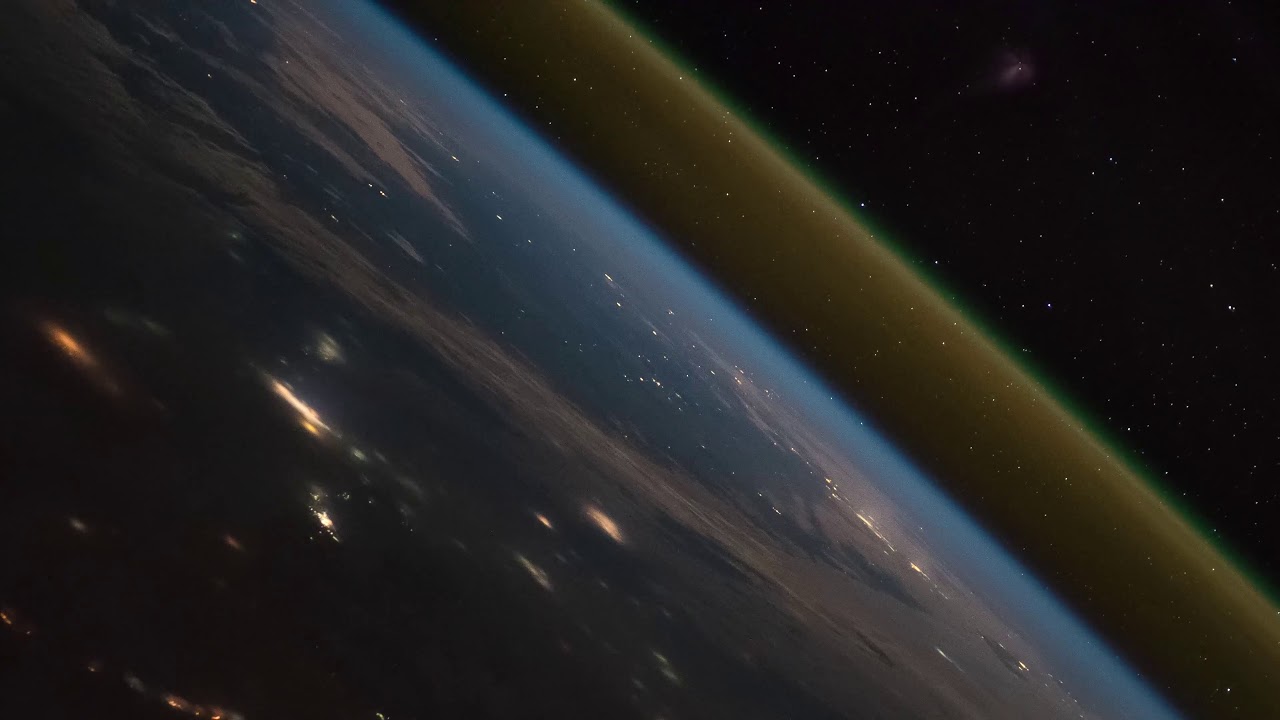
Have you ever seen a rocket launch -- from space? A close inspection of the featured time-lapse video will reveal a rocket rising to Earth orbit as seen from the International Space Station (ISS). The Russian Soyuz-FG rocket was launched ten days ago from the Baikonur Cosmodrome in Kazakhstan, carrying a Progress MS-10 (also 71P) module to bring needed supplies to the ISS. Highlights in the 90-second video (condensing about 15-minutes) include city lights and clouds visible on the Earth on the lower left, blue and gold bands of atmospheric airglow running diagonally across the center, and distant stars on the upper right that set behind the Earth. A lower stage can be seen falling back to Earth as the robotic supply ship fires its thrusters and begins to close on the ISS, a space laboratory that is celebrating its 20th anniversary this month. Currently, three astronauts live aboard the Earth-orbiting ISS, and conduct, among more practical duties, numerous science experiments that expand human knowledge and enable future commercial industry in low Earth orbit.
from NASA https://ift.tt/2DLdlrl
via IFTTT
Have you ever seen a rocket launch -- from space? A close inspection of the featured time-lapse video will reveal a rocket rising to Earth orbit as seen from the International Space Station (ISS). The Russian Soyuz-FG rocket was launched ten days ago from the Baikonur Cosmodrome in Kazakhstan, carrying a Progress MS-10 (also 71P) module to bring needed supplies to the ISS. Highlights in the 90-second video (condensing about 15-minutes) include city lights and clouds visible on the Earth on the lower left, blue and gold bands of atmospheric airglow running diagonally across the center, and distant stars on the upper right that set behind the Earth. A lower stage can be seen falling back to Earth as the robotic supply ship fires its thrusters and begins to close on the ISS, a space laboratory that is celebrating its 20th anniversary this month. Currently, three astronauts live aboard the Earth-orbiting ISS, and conduct, among more practical duties, numerous science experiments that expand human knowledge and enable future commercial industry in low Earth orbit.
from NASA https://ift.tt/2DLdlrl
via IFTTT