
Astronomy news update from NASA : 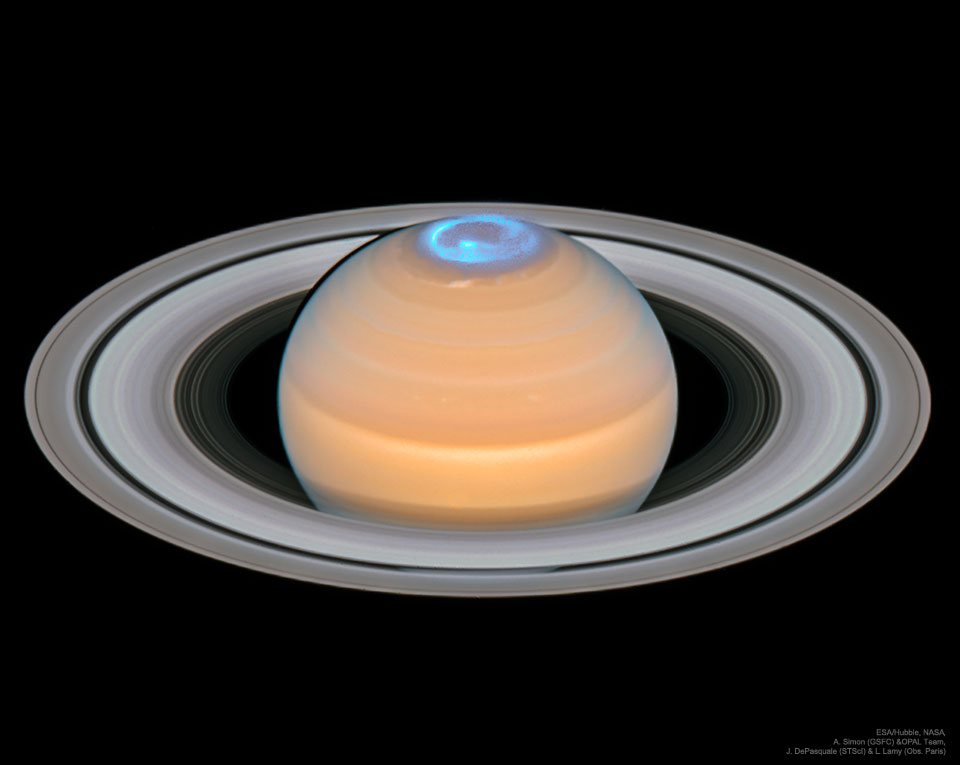
Are Saturn's auroras like Earth's? To help answer this question, the Hubble Space Telescope and the Cassini spacecraft monitored Saturn's North Pole simultaneously during Cassini's final orbits around the gas giant in September 2017. During this time, Saturn's tilt caused its North Pole to be clearly visible from Earth. The featured image is a composite of ultraviolet images of aurora and optical images of Saturn's clouds and rings, all taken recently by Hubble. Like on Earth, Saturn's northern auroras can make total or partial rings around the pole. Unlike on Earth, however, Saturn's auroras are frequently spirals -- and more likely to peak in brightness just before midnight and dawn. In contrast to Jupiter's auroras, Saturn's auroras appear better related to connecting Saturn's internal magnetic field to the nearby, variable, solar wind. Saturn's southern auroras were similarly imaged back in 2004 when the planet's South Pole was clearly visible to Earth.
from NASA https://ift.tt/2NIcNox
via IFTTT
Are Saturn's auroras like Earth's? To help answer this question, the Hubble Space Telescope and the Cassini spacecraft monitored Saturn's North Pole simultaneously during Cassini's final orbits around the gas giant in September 2017. During this time, Saturn's tilt caused its North Pole to be clearly visible from Earth. The featured image is a composite of ultraviolet images of aurora and optical images of Saturn's clouds and rings, all taken recently by Hubble. Like on Earth, Saturn's northern auroras can make total or partial rings around the pole. Unlike on Earth, however, Saturn's auroras are frequently spirals -- and more likely to peak in brightness just before midnight and dawn. In contrast to Jupiter's auroras, Saturn's auroras appear better related to connecting Saturn's internal magnetic field to the nearby, variable, solar wind. Saturn's southern auroras were similarly imaged back in 2004 when the planet's South Pole was clearly visible to Earth.
from NASA https://ift.tt/2NIcNox
via IFTTT

Our new 'Word Of The Day' article update : thrice , adv :
(dated) Three times.
(dated) Three times.

Watch This Dog Flawlessly Jump Through A Gate via Digg https://ift.tt/2wy4bKK
Astronomy news update from NASA : 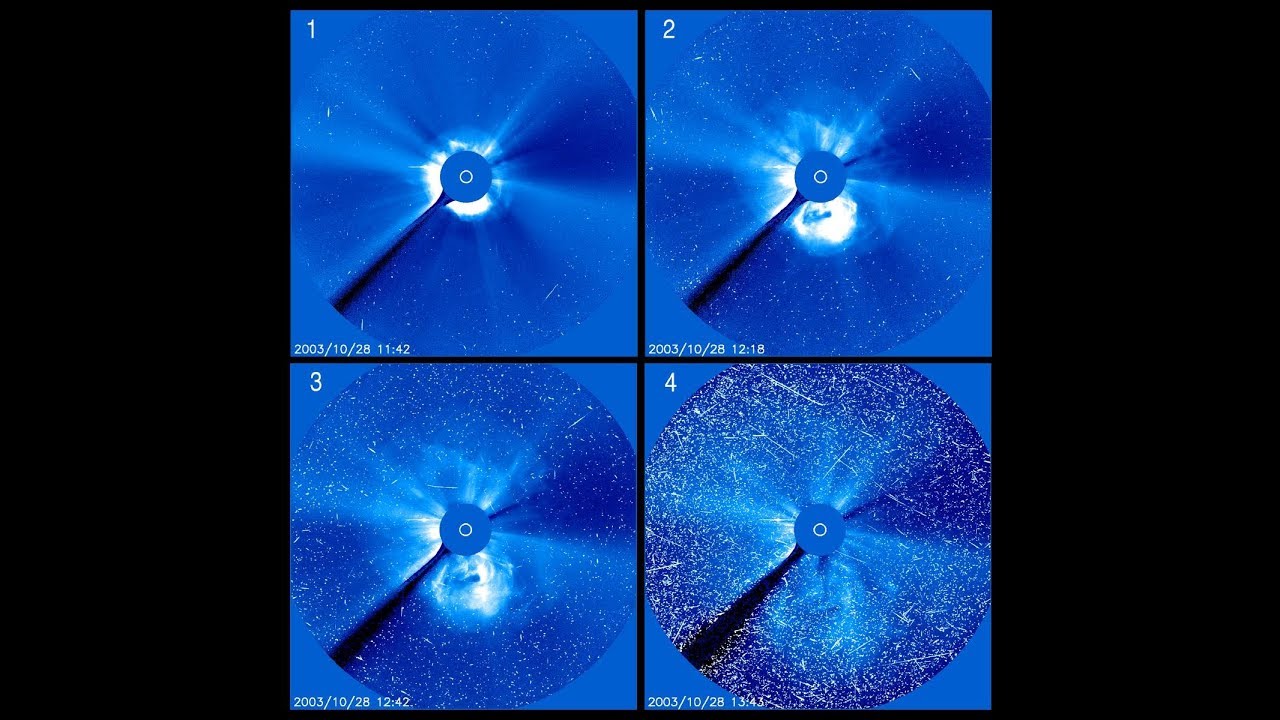
It was one of the most powerful solar flares in recorded history. Occurring in 2003 and seen across the electromagnetic spectrum, the Sun briefly became over 100 times brighter in X-rays than normal. The day after this tremendous X 17 solar flare -- and subsequent Coronal Mass Ejection (CME) -- energetic particles emitted from the explosions struck the Earth, creating auroras and affecting satellites. The spacecraft that took these frames -- SOHO -- was put in a turtle-like safe mode to avoid further damage from this and subsequent solar particle storms. The featured time-lapse movie condenses into 10 seconds events that occurred over 4 hours. The CME, visible around the central sun-shade, appears about three-quarters of the way through the video, while frames toward the very end are progressively noisier as protons from the explosions strike SOHO's LASCO detector. One this day in 1859, the effects of an even more powerful solar storm caused telegraphs on Earth to spark in what is known as the Carrington Event. Powerful solar storms such as these may create beautiful aurora-filled skies, but they also pose a real danger as they can damage satellites and even power grids across the Earth.
from NASA https://ift.tt/2NEaX8a
via IFTTT
It was one of the most powerful solar flares in recorded history. Occurring in 2003 and seen across the electromagnetic spectrum, the Sun briefly became over 100 times brighter in X-rays than normal. The day after this tremendous X 17 solar flare -- and subsequent Coronal Mass Ejection (CME) -- energetic particles emitted from the explosions struck the Earth, creating auroras and affecting satellites. The spacecraft that took these frames -- SOHO -- was put in a turtle-like safe mode to avoid further damage from this and subsequent solar particle storms. The featured time-lapse movie condenses into 10 seconds events that occurred over 4 hours. The CME, visible around the central sun-shade, appears about three-quarters of the way through the video, while frames toward the very end are progressively noisier as protons from the explosions strike SOHO's LASCO detector. One this day in 1859, the effects of an even more powerful solar storm caused telegraphs on Earth to spark in what is known as the Carrington Event. Powerful solar storms such as these may create beautiful aurora-filled skies, but they also pose a real danger as they can damage satellites and even power grids across the Earth.
from NASA https://ift.tt/2NEaX8a
via IFTTT
Our new 'Word Of The Day' article update : dernier , adj :
(dated) Final, last.
(dated) Final, last.


