

Astronomy news update from NASA : 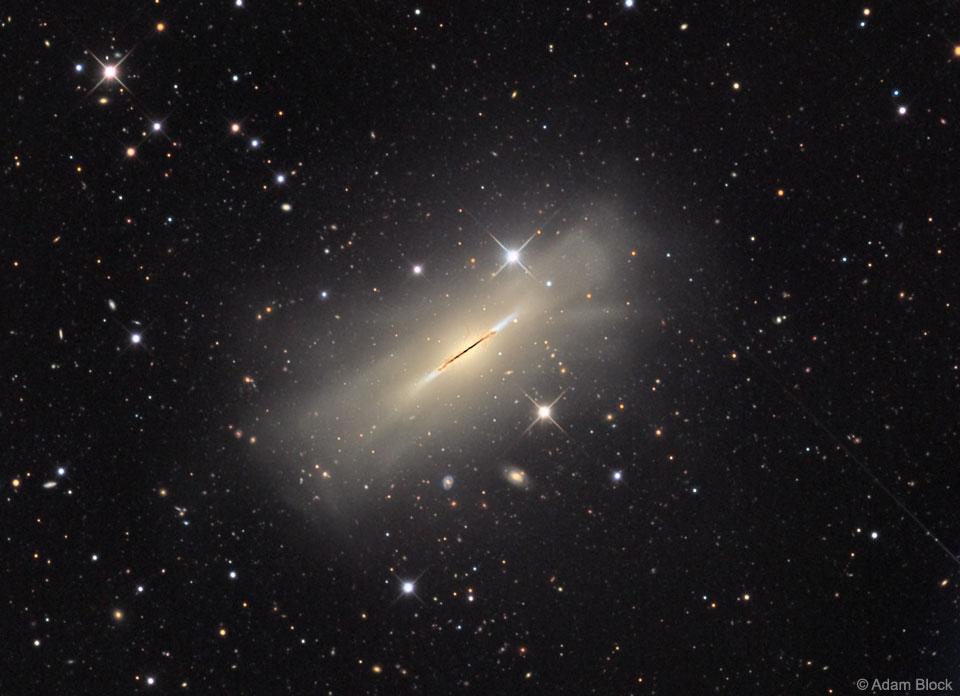
What kind of celestial object is this? A relatively normal galaxy -- but seen from its edge. Many disk galaxies are actually just as thin as NGC 5866, pictured here, but are not seen edge-on from our vantage point. A perhaps more familiar galaxy seen edge-on is our own Milky Way Galaxy. Cataloged as M102 and NGC 5866, the Spindle galaxy has numerous and complex dust lanes appearing dark and red, while many of the bright stars in the disk give it a more blue underlying hue. The blue disk of young stars can be seen extending past the dust in the extremely thin galactic plane. There is evidence that the Spindle galaxy has cannibalized smaller galaxies over the past billion years or so, including multiple streams of faint stars, dark dust that extends away from the main galactic plane, and a surrounding group of galaxies (not shown). In general, many disk galaxies become thin because the gas that forms them collides with itself as it rotates about the gravitational center. The Spindle galaxy lies about 50 million light years distant toward the constellation of the Dragon (Draco).
from NASA https://ift.tt/2A7FIjr
via IFTTT
What kind of celestial object is this? A relatively normal galaxy -- but seen from its edge. Many disk galaxies are actually just as thin as NGC 5866, pictured here, but are not seen edge-on from our vantage point. A perhaps more familiar galaxy seen edge-on is our own Milky Way Galaxy. Cataloged as M102 and NGC 5866, the Spindle galaxy has numerous and complex dust lanes appearing dark and red, while many of the bright stars in the disk give it a more blue underlying hue. The blue disk of young stars can be seen extending past the dust in the extremely thin galactic plane. There is evidence that the Spindle galaxy has cannibalized smaller galaxies over the past billion years or so, including multiple streams of faint stars, dark dust that extends away from the main galactic plane, and a surrounding group of galaxies (not shown). In general, many disk galaxies become thin because the gas that forms them collides with itself as it rotates about the gravitational center. The Spindle galaxy lies about 50 million light years distant toward the constellation of the Dragon (Draco).
from NASA https://ift.tt/2A7FIjr
via IFTTT
Our new 'Word Of The Day' article update : mink , n :
(plural mink or minks) Any of various semi-aquatic, carnivorous mammals in the Mustelinae subfamily, similar to weasels, with dark fur, native to Europe and America, of which two species in different genera are extant: the American mink (Neovison vison) and the European mink (Mustela lutreola). (plural mink) The fur or pelt of a mink, used to make apparel. (plural minks) An article of clothing made of mink. (slang, pejorative, Scotland) (plural minks) An individual with poor personal hygiene; a smelly person.
(plural mink or minks) Any of various semi-aquatic, carnivorous mammals in the Mustelinae subfamily, similar to weasels, with dark fur, native to Europe and America, of which two species in different genera are extant: the American mink (Neovison vison) and the European mink (Mustela lutreola). (plural mink) The fur or pelt of a mink, used to make apparel. (plural minks) An article of clothing made of mink. (slang, pejorative, Scotland) (plural minks) An individual with poor personal hygiene; a smelly person.

I Tried Ketamine To Treat My Depression. Within A Day, I Felt Relief via Digg https://ift.tt/2mKN5E9
Hello, Information from NASA NASA Television will air a conversation about the progress and promise of NASA’s James Webb Space Telescope with Nobel Prize winner John Mather at 2 p.m. EDT Wednesday, July 25.
July 24, 2018
from NASA https://ift.tt/2A85ggk
July 24, 2018
from NASA https://ift.tt/2A85ggk


#/media/File:Drop_spindles.jpg)