
Hello, Information from NASA Experiments investigating cellular biology, Earth science and artificial intelligence are among the research heading to the International Space Station following Friday’s launch of a NASA-contracted SpaceX Dragon spacecraft at 5:42 a.m. EDT.
June 29, 2018
from NASA https://ift.tt/2Kkgwe6
June 29, 2018
from NASA https://ift.tt/2Kkgwe6
Astronomy news update from NASA : 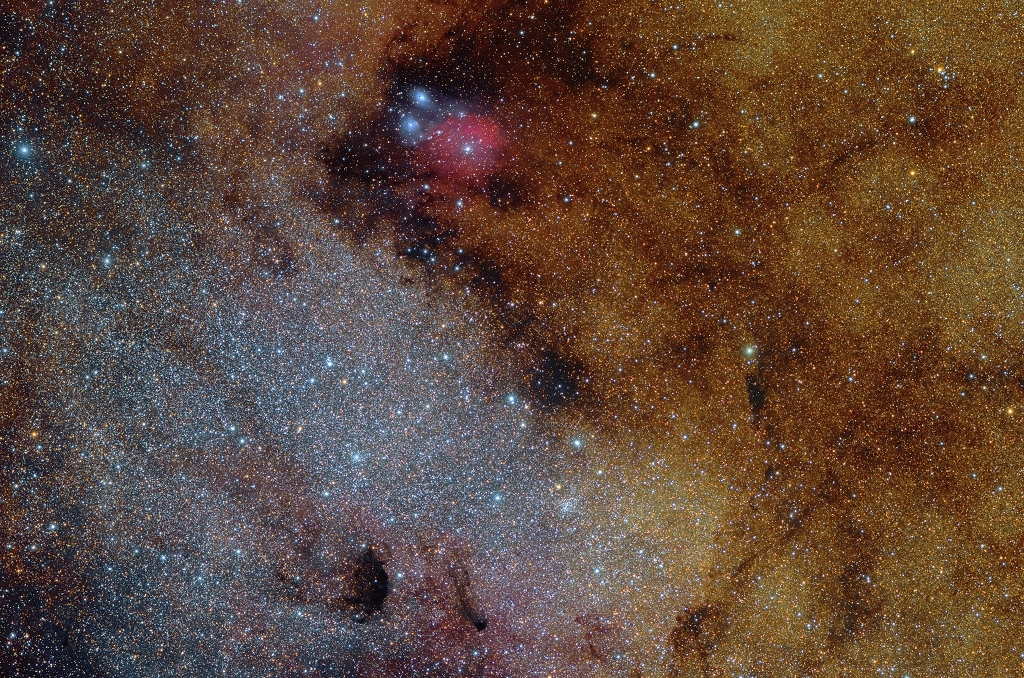
Unlike most entries in Charles Messier's famous catalog of deep sky objects, M24 is not a bright galaxy, star cluster, or nebula. It's a gap in nearby, obscuring intertellar dust clouds that allows a view of the distant stars in the Sagittarius spiral arm of our Milky Way galaxy. When you gaze at the star cloud with binoculars or small telescope you are looking through a window over 300 light-years wide at stars some 10,000 light-years or more from Earth. Sometimes called the Small Sagittarius Star Cloud, M24's luminous stars fill the left side of this gorgeous starscape. Covering about 4 degrees or the width of 8 full moons in the constellation Sagittarius, the telescopic field of view contains many small, dense clouds of dust and nebulae toward the center of the Milky Way, including reddish emission from IC 1284 near the top of the frame.
from NASA https://ift.tt/2NaRJXN
via IFTTT
Unlike most entries in Charles Messier's famous catalog of deep sky objects, M24 is not a bright galaxy, star cluster, or nebula. It's a gap in nearby, obscuring intertellar dust clouds that allows a view of the distant stars in the Sagittarius spiral arm of our Milky Way galaxy. When you gaze at the star cloud with binoculars or small telescope you are looking through a window over 300 light-years wide at stars some 10,000 light-years or more from Earth. Sometimes called the Small Sagittarius Star Cloud, M24's luminous stars fill the left side of this gorgeous starscape. Covering about 4 degrees or the width of 8 full moons in the constellation Sagittarius, the telescopic field of view contains many small, dense clouds of dust and nebulae toward the center of the Milky Way, including reddish emission from IC 1284 near the top of the frame.
from NASA https://ift.tt/2NaRJXN
via IFTTT

Astronomy news update from NASA : 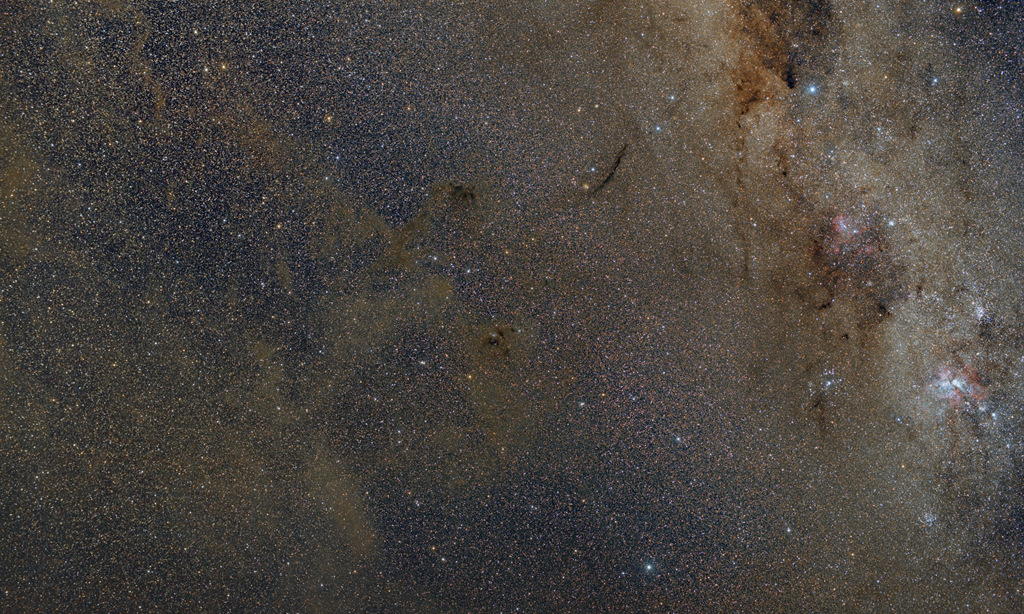
South pole star Sigma Octantis (of the constellation Octans) is on the left of this starry expanse spanning over 40 degrees across far southern skies. You'll have to look hard to find it, though. The southern hemisphere's faint counterpart to the north star Polaris, Sigma Octantis is a little over one degree from the South Celestial Pole. Also known as Polaris Australis, Sigma Octantis is below 5th magnitude, some 25 times fainter than Polaris and not easy to see with the unaided eye. In fact, it may be the faintest star depicted on a national flag. The remarkable deep and wide-field view also covers faint, dusty galactic cirrus clouds, bounded at the right by the star clusters and nebulae along the southern reaches of plane of our Milky Way galaxy. Near the upper right corner is yellowish Gamma Crucis, the top of the Southern Cross. Easy to pick out above and right of center is the long Dark Doodad nebula in the southern constellation Musca, the Fly.
from NASA https://ift.tt/2lGKBpM
via IFTTT
South pole star Sigma Octantis (of the constellation Octans) is on the left of this starry expanse spanning over 40 degrees across far southern skies. You'll have to look hard to find it, though. The southern hemisphere's faint counterpart to the north star Polaris, Sigma Octantis is a little over one degree from the South Celestial Pole. Also known as Polaris Australis, Sigma Octantis is below 5th magnitude, some 25 times fainter than Polaris and not easy to see with the unaided eye. In fact, it may be the faintest star depicted on a national flag. The remarkable deep and wide-field view also covers faint, dusty galactic cirrus clouds, bounded at the right by the star clusters and nebulae along the southern reaches of plane of our Milky Way galaxy. Near the upper right corner is yellowish Gamma Crucis, the top of the Southern Cross. Easy to pick out above and right of center is the long Dark Doodad nebula in the southern constellation Musca, the Fly.
from NASA https://ift.tt/2lGKBpM
via IFTTT


